Showing posts with label Ada Fetters. Show all posts

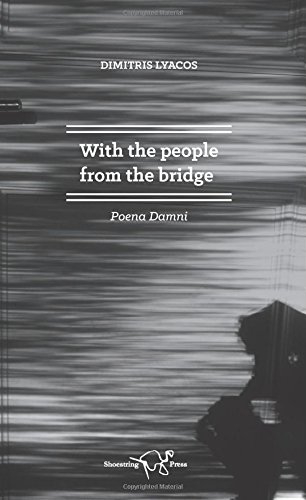
Review of Dimitris Lyacos's
With the People from the Bridge
—Review by Editor Ada Fetters

It is often said that good stories “show instead of tell.” Dimitris Lyacos’s With the People from the Bridge gives such a deeply felt sense of what it must feel like for a vampire to awake from the grave or the morgue that Lyacos never has to tell his readers vampire. He never says grave,nor does he say undead. All we hear are the voices of the urban vampires congregating and telling their stories in minimalist form that sounds like the short, earth-clogged remarks of vocal chords that aren’t quite working the way they used to.

Their narratives are all the more powerful because of what we are and are not told. Certain things are taken as a given, as they would be for the undead: they were all disinterred or awakened, there is no need to say this explicitly. However, their circumstances are described in striking physical detail.

“Then I sat upright for a while. Dizzy.
I couldn’t close my mouth.
Open. I couldn’t.
It was frozen. There was something inside
and he took it out. It had dried
and it hurt me.”

The image that came to mind for me was garlic in the person’s mouth, the dried papery skin of the garlic sticking to the tissues of the tongue and throat. I could be wrong about this, certainly, but part of the fun of such minimalist poetry is the playful nature between the poet and his reader. Lyacos sketches in enough sensation and detail for readers to shudder as they fill in the gruesome details in their own mind. If you enjoy new perspectives that change familiar themes to the unfamiliar, if you enjoy a poet who draws you in by inviting you to participate in the world he creates, and if you are a fan of the undead, then With the People from the Bridge is for you.
___

Ada Fetters has been published in The Journal of Humanistic Psychology, Copperwood Review, Humanist Magazine, Niche, Tertulia, Debris, Poetry Pacific Magazine, Pink.Girl.Ink and most recently in Bewildering Stories.
Retroactive Metaphor:
Keri Hulme's The Bone People
—Review by Ada Fetters

I genuinely cannot decide whether or not I like Keri Hulme’s The Bone People. The writing itself is beautiful. The characters are strong. The plot is intriguing. The resolution, however, bothers me enough to make me question whether I like the book.

The story revolves around three characters: Joe Gillayley, his adopted son Simon, and their prickly acquaintance Kerewin. All three are trying to escape their past. Seven-year-old Simon was found on the shore several years ago, the only survivor of a terrible shipwreck that left him so traumatized that he refuses to speak. Kerewin is estranged from her family, mostly her own fault. Joe has led a life of disappointment and also can't seem to come to terms with his Maori ancestry.

The book explores themes of culture, love, violence and loss. These things feel very real.
I think I accidentally found one of the influences for The Bone People, that is, the diary of Opal Whitely. Am not saying that this takes away from the writing or makes it less beautiful, just that the kind of person who would write a book like The Bone People would very likely have enjoyed the writings of Opal Whiteley. Also, it is plain that she drew other elements of the book from things around her: the name of Kerewin Holmes, the main character, is very close to the author’s name, Keri Hulme. 

There are strong similarities between Simon Gillayley and Opal Whiteley, or rather, between Simon and people's perception of Opal, which is surprisingly different from the reality.

For those who do not know, Opal Whiteley was born in 1897. She was from a logging town in Oregon but later claimed to be the lost daughter of French nobility. She published several books about nature. Then she published a "diary" she claimed to have written in her childhood, the veracity of which is highly dubious. So here are the similar points between the Opal of the diary and Simon Gillayley.

Opal claimed her biological parents died in a shipwreck and that no one knew who she was. She claimed she was given to the first person to take her. Simon's biological parents died in a shipwreck. No one knew who they were. He was given to the first person to take him.
Opalites (people who take her story at face value) say that Opal didn't make a bigger fuss over her situation at the time because she didn't know who she was or couldn't say. Simon literally "couldn't say," since he was traumatized by the shipwreck and refused to speak.

Opal claimed her real name was Francois. In his mental narration, Simon calls himself Clare or Claro (means "noble" or "bright.").

Opal claimed to be French. Simon freaks out if he hears French spoken.

In her "childhood diary," Opal claimed that her "adoptive" mother beat her and was abusive. (Though in an earlier work she described her childhood as idyllic. Probably the truth lies somewhere in the middle). Meanwhile, Simon's adoptive father does beat him, often, in uncontrollable rages. Again these are similar if your perception is that Opal was telling the truth.

Simon is mute and is teased for this but chooses to express himself in writing. Opal claimed that she was teased for her failure to communicate properly because she often spoke French. Her childhood diary was (she claimed) the expressive writings of her younger self.

Opal wrote a prodigious amount for a seven-year-old. She also uses precocious words, terms, names and so on. She says things that an adult would find charming for a child to say, such as describing someone as "a multiplication table of comfort."

Simon is also seven. He is extremely precocious in his written vocabulary and in his behavior, to the point that he almost doesn't seem like he is seven.

The Opal of the diary was a child of nature. So was Simon.

The Opal of the diary was willful and did things that made sense to her but that looked disobedient and odd to grownups. So does Simon.

Now that I think of it, the writing in The Bone People is rather like that in Opal's "diary." While reading it I wondered where I'd read a rhythm and phrasing like this before. To wit, Opal wrote, "By the wood-shed is a brook. It goes singing on. It's joy-song does sing in my heart."

Bone People has a similar sing-song, the same use of surprising grammar and "it does" verbs. In this case the writing works to the point that the book is mesmerizing.
Both Opal's works and The Bone People are concerned with the land, with nature, with human brutality to each other and to nature. Both feature societal misfits. Both want to take you on a journey of magical realism.

I enjoy magical realism. Calvino, Rushdie, Eco, Kafka, Marquez, and others expect a person to suspend disbelief and go on a meaningful journey. You want me to think about what happens when a man turns into a beetle in a real-life apartment? I'm game. Steven Millhauser, the author of Dangerous Laughter and We Others, is my most recent favorite in this genre. I can't recommend him highly enough.

Thus it was mystifying to me that I was tripped up at the end of Bone People. The world feels real, the interweaving of Maori culture with the mainstream is earthy without being pretentious, the characters are strong, multidimensional, and (mostly) lovable. Even Joe is not simply presented as an ogre, but as a person who has endured a lifetime of depression and frustration. Kerewin is a prickly person who understands the difficult, willful Simon better than most people. However, even when she finds out about Joe's horrible way of dealing with Simon's behavioral issues, she does not alert anyone. 

Whether you agree with her or not, the decision was handled realistically for that character. Kerewin finds that the little town already knows. Joe's relatives already know. They do not like it but they do not want to separate the two by alerting the authorities, which would mean Simon becoming a ward of the state. Would that really be better for a troubled child who had such a hard time becoming attached to anyone? Kerewin reluctantly adopts a "wait and see" approach, resolving to give Joe an attitude adjustment if she sees him treat Simon harshly.

Eventually the authorities find out anyway (more on that in a bit) and Simon goes to the hospital, Joe goes to prison, and Kerewin takes off for lands unknown.

So we come to the ending, which is what tripped me up.

At the end, Kerewin contracts a fatal disease and goes to a wilderness cabin to die alone but is magically cured. I am not sure why this happened or why it then needed a deus ex machina cure. The "tacked on" aspect of both the disease and cure was annoying; the others had manifest problems that needed curing, so Kerewin needed one, too?

Meanwhile, Joe is deeply depressed but finds a spiritual elder and makes peace with himself. The book really sold that one, though, since the whole point is the uneasy existence of his Maori heritage in a predominantly Westernized culture. This was magical-- the voices of his ancestors speak, he comes into contact with powerful forces-- but it was very believable and a heartfelt resolution to a main plot point.

Simon was beaten so badly by Joe that he is in a coma. When he wakes up he has lost most of his hearing. This brings me to my next sticking point.

Joe Gillayley is an abusive parent. That isn't "tacked on." It is established that he beats Simon with his belt to the point that the kid's back has matted scars all over it, the bone underneath is visible (!) and the wounds are infected (I'd be surprised if they weren't). That's not even what gets him arrested and I do not need to say that this is terrible.

The book goes to great lengths to show that Joe and Simon are deeply attached and love each other. This struck something very true and sad about a child's emotional attachment to his caregiver, or the one person who has shown him any love in his short life, though that love comes with a heavy price. Not many books can do this convincingly but Keri Hulme definitely pulls it off. I was impressed.

So what is the problem, you ask?

Joe goes to prison for child abuse and when he gets out, Simon is allowed to go back to him. I say "Simon is allowed," because Simon communicates that he wants to do this and is so stubborn, with such behavioral issues, that the State allows him to go live with Joe. I guess that's what broke my belief in the story. Not that Simon would want to go back-- abused kids often want to do that-- but that it worked. Not only does a kid's wants cut very little ice with the government and the court, but...

1. The book establishes that Joe never formally adopted Simon. He is not legally the kid's parent.

2. This wasn't a one-off. There is clear evidence that the abuse was severe and ongoing.

3. Joe is a single male with a checkered past and a wrecked marriage.

4. The elephant in the room is that Joe is Maori and Simon is white, which makes the ending even more improbable. Is racism nice? No. Does it exist? Yes. Would it affect the court's decision? It would.

I am not trying to nit-pick little things. This is the ending of the book, the culmination of 500 pages, so the payoff has to be believable. Let's face it. A single Maori male with a history of bad relationships and no legal ties to this white kid, who'd put said kid in a coma, and who now has a prison record, would never get custody of that kid.

Weirdly, if the author had gone for all-out suspension of disbelief it would have felt more real. She spends a lot of time describing how Simon worked through the court system etc. in a way that is supposed to be realistic but is not. The ending to Joe's story, speaking to an ancient god and finding self-acceptance, feels more real because it goes all-out and is a meaningful resolution to a plot point. Kerewin lands between the two, with an odd mix of magic and reality that was singularly odd, even outside the fact that it was a solution to what seemed to be a manufactured problem.

At the end of the book, Kerewin, Joe and Simon are all together in a sort of patchwork family. I know this is supposed to be magical realism and the three main characters are supposed to be symbolic. There are clues that hint at Joe symbolizing Maori culture, Simon symbolizing European culture, and Kerewin is part Maori and part European. Perhaps that is why they had such atonal resolutions to their stories?

They all get together at the end and it's relatively okay. I guess. Except it isn't really. The metaphor is strange because if Simon is supposed to be European culture, why is he a nature-child, almost elemental? Why is Joe, Maori-culture, the powerful one who beats up Simon? Shouldn't it be the other way around?

I have tried to look at this several different ways, with several different metaphors, but none of them work well.

It should be said that the story in itself works the way it is. It works until the ending, which is so odd that it only works as a metaphor, but the possible metaphors do not work retroactively for the rest of the story. 


___
Ada Fetters has been published in The Journal of Humanistic Psychology,  Copperwood Review, Humanist Magazine, Niche, Tertulia, Debris, Poetry Pacific Magazine, Pink.Girl.Ink  and most recently in Bewildering Stories.

Wayne F. Burke's Book Dickhead
—Review by Editor Ada Fetters


Dickhead is a new book of poems from Wayne F. Burke, the author of Words that Burn. Dickhead is divided into six sections, each with its own theme, though there are subtle associations woven throughout. You may recognize “Lark up the Nose of Time,” which was published in Commonline Journal. “Lark” will give the prospective reader an accurate idea of the free-wheeling, down-on-his-luck, no-whining, zero-fucks-given attitude they can expect from Burke.

This is a multilayered work from a poet who is keenly aware of his own territory versus that of the Midwest or South or overseas but chooses to forge inroads anyway. He is an earthy pragmatist with a surreal inner life. He is an insomniac dreamer. He is not afraid of a fight but is conscientious of the few fragile things around him.

If Burke’s Dickhead seems paradoxical at times, that is because it is (in part) a coming-of-age story in which a rabbit must metamorphose into a snake. Two very different views of the world co-exist within the narrator. In one of the very first poems, "Mammals & Reptiles," the adults at the zoo watch a snake eat a rabbit. The narrator, then the child, “hops” to the cobra cage where a snake rears up and tries to strike him through the glass. “Showdown” elaborates on this theme. On the surface it appears to be an adolescent conflict, but it is also a rite of passage into the world of cobras. His uncle stares at him

black-eyed
with the glare that used to
pin me like a rabbit
but this time I glared back

By the time this rabbit-turned-cobra has become a “Sophomore,” he speeds “along snaky roads.”

This is a coming-of-age story, yes, but that is only one of the six sections. A potential reader may be tempted think that this review is like one of those irritating movie trailers that show all the best bits of a film before they have a chance to watch it, but I am merely offering a glimpse. There are so many intertwining themes to Dickhead that a reviewer can afford to explore a few of them while still leaving most territory uncharted. These include but are not limited to themes of alienation, loneliness, and a feeling of being driven, without knowing where or by what.

Burke’s work is infused with an East-coast attitude that is often misunderstood as posturing. Yet Dickhead is not bravado or an attempt to shock. It is a way of life. These are not generic poems with place-names inserted. They are rich with associations (some of them intentional, some of them unconscious) peculiar to this area. E.g. flinging his underwear into a river and picturing it found as a white fish: this may be an unconscious association to the “Allegheny whitefish.” This kind of deeply ingrained association means that Dickhead is about more than mere location. It is a mindset and a way of interacting with the world.

The first poem, “One,” sets the tone when the narrator sees

a guy who looks like me:
I clench my fists
in case he tries to
get tough

The narrator is not the only one with this habitual reaction to the appearance of himself in others. In “Old Buddy,” a long-time friend sees himself in the narrator’s mirror-glasses and readies himself to attack—the narrator chooses to defuse the situation by removing his glasses.

Paradoxically, while craziness is a way of life (“are you loco?” / “yes, I am”) the narrator is not a loose cannon. He silently considers whether or not he will have to break a man’s hand in “The Faamer.” When working as a security guard, he

“hoped no one would break in
and bother me”

This speaks more to wanting everyone out of his face than it to getting into the faces of others. Dickhead is full of paradoxical twists, wordplay, subtle associations and darkly funny atmosphere. In the poem “Buk,” the poet muses on being compared to Bukowski. Burke describes Bukowski as the

comedy-maker
crafty
sly
honest
liar

If a speaker's accent involves fat vowels (i.e. “Faamer” for Farmer), Burke sounds a lot like Buk.

___
The Author: Wayne Burke's work has appeared in FORGE, miller's pond, and Northeast Corridor. He was poet-of-the-month in Bareback, 7-13.

___
The Editor: Ada Fetters has been published in The Journal of Humanistic Psychology, Copperwood Review, Humanist Magazine, Niche, Tertulia, Debris, Poetry Pacific Magazine, Pink.Girl.Ink and most recently in Bewildering Stories.

What Drove Mad Max Crazy?
—an Editor's note by Ada Fetters

George Miller’s Fury Road delighted me in a way that no action movie has done in years. That isn’t exactly a surprise and if you want a review of Fury Road you can visit Red Letter Media, which did a great job with an honest and accurate movie review. No, this is more about the meta of Mad Max.
The movie stands alone but because I wanted to know where Fury Road came from, I decided to watch the earlier movies in the “Mad Max” saga. I also thought it might help me to tease out what I liked about this world. Usually I am bored with the action movie genre. It does not take long to figure out what the rules are, what the narrative is, and where this is going. I am already there, waiting for the movie to catch up.
Because of a movie-site quirk I ended up watching them in reverse order.  I knew I liked the mixture of goofy, over-the-top, crazy, WTF elements with realistic, practical elements. I knew I liked the fact that if Max is injured, he doesn’t immediately bounce back just because the plot might want him to. After watching the first movie last, I finally figured out what was intriguing about all of this. There is a method to the madness. There is meta to Max.
Anyone vaguely familiar with this saga knows that the character of Max Rockatansky is crazy because he lost his family and crazier because he cannot fix what is broken. But what is broken? The world? Yes, but not quite in the way the audience assumes. In Road Warrior one of the other characters berates Max because at this point everyone has gone through the fall of civilization and they have all lost people they love. They have suffered without giving up hope, so why is he being such a little punk? The guy assumes the answer to his own question, gets in Max’s face, and Max is so distressed that he punches the guy in the mouth.
Needless to say, this works toward the point of the movie in itself, which is that Max is a weird, broken loner who doesn’t want to have to care about anything.
This raises the question, though: why is he different? Why don’t we dismiss him as a whiny little punk? What would his answer have been? Most people assume they know but nearly every time the viewer is tempted to assume things in a Mad Max movie, George Miller shows them that what was really happening was quite different from the expectation. This is part of what makes the movies odd and entertaining. It’s perfectly possible to take these things as strange elements in a cheesy action movie. They work fine that way. There’s more to it, however.  
So what was his real answer? What was it that Max could not say?


The answer is in the original movie, though the others point to it if the viewer pays attention. Let’s go down this rabbit hole.
In the original Mad Max the world is falling apart but hasn't completely unraveled. There is no rioting in the little town where Max’s family lives. There are no fires or big fortified walls with corrugated tin. As a Walking Dead fan I wondered whether this was an apocalypse or not. How can you have a proper apocalypse without corrugated tin barriers?
The place is fairly peaceful because it is in the middle of nowhere and the local police force cruises around keeping random crazy people from causing too much trouble in the immediate vicinity. Again, the world has not completely fallen apart yet so people still go to the store and get bread or eat at the one restaurant in town or go to the police if someone wronged them. Things still work well enough that at first the gang of colorful baddies seems like a vaguely alarming but temporary problem, much like a motorcycle gang in a Marlon Brando movie.
However, it soon becomes plain that the dynamic is different. Society is not basically ok with a reckless bad element that just "haven't found their place" the way it is in a black-and-white movie starring Brando. The police (including the young Max) are propping up a failed infrastructure. Help is not on the way.
There are lots of cars, 'splosions, chasing, motorcycles etc. There are all the things that you’d expect from an action movie about fast cars. However, George Miller put many little visual jokes and aberrations in the background that give the viewer clues about what might really be going on. For example, the audience sees a couple reclining in the back seat of a car. The guy’s arm is at an angle that obscures her chest, and his torso is obscuring her other naughty bits. The guy is shown from the waist up.
This is the typical positioning cue for a viewer to assume that naughty bits are implied but thanks to the convenient camera angle we don’t get to see them. We assume what is behind the man’s arm. We assume their past activity.  Then the guy puts his arm down and gets up:  she was wearing a tube top and shorts and the man was wearing jeans. They could have been eating lunch. They could have been doing anything, but the viewer was putting a narrative onto them. This is a reminder that if we want to know what is going on beyond the basic plot, “Innocent Kid Becomes Disillusioned,” we should not be so quick to assume what is in the obscured spaces in these movies.
Remember, Max’s refusal to answer the direct question in Road Warrior counts as a blank space or ellipsis.
Our main character himself is a sweet kid at the beginning of the first movie. Because I saw the movies in reverse order this was sad in an unintended way. Here he is chattering and laughing and juggling apples, confident that things are going to get better or at least maintain a steady state. If you watch them in reverse order, you know that this kid will end up as a baseline-psychotic burnout with a thousand-yard stare.
Remember the couple from a paragraph ago? The motorcycle gang catches them, of course. You see the gang beating the guy's bright red car to pieces. This is the most visceral scene in the movie, with oil and other vital mechanical fluids splattering all over the place until the car is only good for salvage. The wrecking of the car is symbolic, of course. The audience does not see what happens to the couple themselves, but we again assume. The police (Max and his partner) show up to see the woman passed out and her boyfriend running away across the field, which seems funny at first. The motorcycle gang is gone. The woman curls into a terrified ball despite the officers' assurances that everything will be alright. The audience assumes they know what happened to her until the camera angle allows to you notice (if you're paying attention) that she still has all her clothes on. Her boyfriend did not.
I mention this because it is an unexpected reversal, it rewards the attentive, and because it motions to the point of the movie. A person doesn't have to be physically harmed themselves to lose their mind: it is possible to drive someone crazy by making them lose enough of what they care about, and telling them “it’s alright” after they have seen that it isn’t will make things worse. There is more to this whole thing than that, however.  
Max begins to lose things he cares about. After his police-partner meets a lingering death, his faith in the “everything is alright” narrative is shaken. The boss tells him to go on vacation-- what someone in 2015 would call "some mental health time.”
At one point he and his wife are in their bungalow and you hear saxophone music and this is the cue for you think they are having the sexy-times. But his wife is playing the saxophone with great enthusiasm while Max looks at her with the expression of a cat trying to figure out why his human is talking to a piece of plastic. She then calmly sets the instrument aside and the scene begins.
These things are goofy and funny, but they are more than that. They are pointing the meta of these movies, which is more than the fact that a post-apocalyptic world is “not alright.”
The motorcycle gang catches up to Max and his wife and the baby, as we knew they would. Afterward she is dying in what passes for a hospital and the people who pass for doctors are conferring. The kid is dead, she's dying, but she was young and healthy so her organs should be able to save someone else (salvage). They try to decide who has to tell Max and impart the message that "She's dead but everything will be ok."
The camera backs up. Turns out that Max was on the other side of the literal fourth wall and he is  devastated but he is also trying to understand what just happened. The saxophone trick has gone horribly wrong. This was supposed to be for your benefit as the audience. Max wasn't supposed to hear it any more than he was supposed to hear the saxophone soundtrack and what first seemed like a trope-- little wifey's death exposition that the audience takes for granted-- tips Max over the edge. It's not only what happened in itself that drives him crazy, it's the action-hero world mechanics. That is what is wrong, that is why we do not dismiss Max as a whiny punk for dealing with the same thing as the other people in his world. He isn’t dealing with quite the same thing. He keeps catching glimpses outside the fourth wall and so instead of becoming depressed or afraid, he loses his mind.
This is why Max’s thousand-yard-stare is the most disquieting when he seems to be looking through the world and at the viewer.
He does not come unglued or shout or give convenient exposition about his mental state the way someone in a movie usually does. What he is thinking seems to be none of the audience's business. The villains are over-acted, Max is under-acted. In this, he is reacting the way a real person would react to a movie world, not the way an action-hero plot puppet would react. That is the Meta of Mad Max.
The villains in these movies are always over-the-top, flamboyant, colorful and played with gleeful relish. They are like evil and dangerous Muppets who want to rob, rape and kill you. Even their names are crazy-muppet-names. They are much more suited to their world than Max is.
The villains act with reckless abandon but Max is not a force of nature or unstoppable. If he tries to do action movie things (swing on a chain across a gorge in Fury Road or have a vengeful car chase in the original) they rarely work. Things that Action Hero Man and his audience usually take for granted are a federal fucking issue for Max and it seems to take him forever to get anything done. When he does finally manage to confront the motorcycle gang, he does not stand tall like Clint Eastwood or the Duke, who are larger than life. He is immediately shot in the leg and while he is on the ground trying to reach for his own gun, they run over his reaching arm with a motorcycle.
A typical Action Hero plot-puppet will bounce back after psychological trauma because that is what the plot needs him to do: he is nominally troubled but otherwise fully functional. He is supposed to bounce back after physical trauma as well. After all, what is the use of a hero who can't run?
Unfortunately for Max, this too is a federal issue. He can be badly injured in an instant but the effects of the injury last. He wears a leg brace in Road Warrior and apparently his leg is never quite right again, which is not surprising for a kneecap shot. He can run for short distances but must soon slow to a walk. Even in Fury Road, his leg is as healed as it's ever going to be (he has "no busted limbs, multiple scars") but still wears the leg harness. The audience gets this information at a permanent cost to Max: if this is anything like the other movies, the words tattooed into his back are not going away any more than the scars and bad leg.
These things are part of the background. They are not the point of any of the scenes they are in. If you want to you can gloss over them. The movies are surreal and funny and if what you want is an action movie with explosions you’ll get it and then some. The weirdness is part of what makes these movies enjoyable.
The other characters have a penchant for telling Max who and what he is. They are insistent about what he is meant to do here. He does not look resolute or heroic. He also doesn't respond in a melodramatic "fighting against destiny" fashion. He just looks dubious. The world mechanics want Max to be an Action-Hero Muppet but he consistently fails to do so unless dragged physically into the plot. George Miller subverts expectations by putting a character meant to be a real person in a crazy world. A real person cannot save everyone, let alone fix the mechanics of his entire world. The concept echoes the "Marlon Brando Will Save Us" mantra from Chronic City.   The quick version is that Brando was outside the fourth wall. One of the characters in Chronic City was aware that he was living in a fiction. He claimed that Marlon Brando was not only aware of the fourth wall but also knew about the meta-mechanics of what was going on: during production of The Score Brando became upset with Frank Oz (director) and only referred to Oz as “Miss Piggy.” Brando came on set stripped from the waist down. This bizarre form of protest was Brando proving that even if Oz only shot him from the waist up, the actor had a bottom half. He was not a puppet, not even when the director himself was moved by plot convenience.
Max does not want to get drawn into things. Yes, of course within the regular story he is a reluctant hero or perhaps even an anti-hero. Outside of the movie in itself, his crazy eyes see the strings of yet another story trying to wind themselves around him and does not want this to be another federal issue. Hence his protest, “I’m just here for the gas,” which he keeps repeating in an increasingly discouraged tone. 
The character of Max Rockatansky is just aware enough of the fourth wall, the strings yanking on him, and what he fails to be, for these things to drive him insane. He can't save everyone from the world or its sinister mechanics. That is what was lurking in the blank space behind his inability to answer when another character demanded to know why he was malfunctioning as a hero.

If you like a simple action adventure movie, you can assume the character berating him is correct and Max is just a horrible person, much the way you can assume that Brando was not stripped below the frame in The Score because that was never shown.
The Mad Max saga works either way. You can choose to only look at what is shown, or you can peer into in the spaces behind what is shown, which is a testament to Miller’s skill as a storyteller. 

_
The Editor, Ada Fetters has been published in The Journal of Humanistic Psychology, Copperwood Review, Humanist Magazine, Niche, Tertulia, Debris, Poetry Pacific Magazine, Pink.Girl.Ink and most recently in Bewildering Stories.
_
The Artist: Eric Hanna is a philosophy teacher from central Canada. He informs us that his poetic influences include JRR Tolkien and Tom Waits. In his free time he enjoys writing, especially about himself in the third person.

Monochrome Morality or, a review of Cormack McCarthy's "The Road"
—an editor's note by Ada Fetters

I recently finished reading Cormac McCarthy's The Road.

The short version: The writing is excellent in itself, though all the facts are wrong, in an odd enough way that at first I wondered if the uneven tone meant it was a brilliant parody.
The long version:

The writing itself is enthralling and I had a difficult time breaking off even though it is generally not advisable to read hopeless post-apocalyptic novels after midnight. Our two main characters, a nameless man and his son, travel the eponymous Road through a dangerous, barren landscape.

In this book the earth has suffered a massive cataclysm, the nature of which is unknown. The closest we get to an explanation is that there was a blinding flash of light, then the power went out, and the world caught fire. The man was raised and lives in the backwoods, so he and his family escaped the rioting and have some survival skills. Later we see that entire populations were caught in this conflagration. We see lines of burned-out cars on highways, buildings askew because their foundations began to melt. Such buildings have a glaze of melted glass on them like glaze on a donut. This is a lovely image, but would glass quietly melt and drizzle down the outsides of buildings? Or would it blow outward/inward violently and melt where it landed?

The descriptions in this book are astonishing and would be even more so if the author cared more about how things work.

Ash and smoke blow across the earth, the planet gets colder, nothing will grow. The man and his son live off of whatever canned food they can scavenge. They nourish themselves from the remnants of a departed goodness.

Oddly, fire destroyed the world and yet the main character and his son refer to themselves as "the good guys" and "carrying the fire." While "good guys" is reasonably clear (they do not kill other people, they do not rape, they do not steal from others), they do not specify what their fire is. They also do not explain why they refer to it this way when the planet-killing blaze is enough fire and to spare.

It may or may not be faith in a god. McCarthy is deliberately vague. It might be hope for the future. It might be the fact that although the few people left after the end of the world as we know it have resorted to cannibalism to stay alive, even eating the few infants born, the man and his son will not do this. They do not consume their own future even though it is essentially hopeless. However, a band of people would not profit from feeding and making allowances for a pregnant woman just to eat the infant. There would be no caloric benefit from keeping a bunch of pregnant women the way readers are shown that "they" do.

According to the story the world has been this way for years... a horrifying monochrome world and gray sky. However (says the Editor, not McCarthy) there must be plant life somewhere because the characters are breathing oxygen, which would be in short supply after worldwide fires hot enough to burn cities and the decay of all the fish, since we are told repeatedly the oceans and lakes are dead, which would produce lethal amounts of carbon dioxide.

I am not a biologist or climatologist, however, I know enough not to burn a candle in a closed-off cave after a landslide. It seems reasonable that somewhere there are trees, or possibly just algae or plankton or stromatolites - the humble creatures that originally evolved in a tumultuous volcanic earth and eventually put out so much oxygen that it filled the atmosphere.


Stromatolites look like rocks, but they're our most distant living relatives. Remember, the boy born just after this disaster is somewhere between ten and fifteen, at the age when (the writer tells us) in a normal society, he'd begin to put up boundaries between himself and his father. If this scenario has been going on that long, then plant life would have to be quietly converting all that carbon dioxide into breathable air or the characters would be suffocated.

However, that isn't the point of the story. This is not science-fiction, it is horror. As Mike Nelson, Crow and Tom Servo say, "If you're wondering how he eats and breathes, and other science facts / Then repeat to yourself, 'it's just a show, I should really just relax.'" 

Readers are treated - and I do mean treated, if you are a horror fan - to terrible ashen landscapes and dull red horizons. Never has monochrome been used so vividly. We are treated to an image of dead oceans with, perhaps, a giant squid in the inky blackness of the far deep. The squid is a despairing horror-thought of the man and so it is a haunting image and not something that bounces a person out of the story. You see the difference here.  

Yet if you can get past the odd physics ("it's just a show") you can enjoy McCarthy's euphonic prose washing over you.

McCarthy also tells readers that whatever happened, no one escaped earth. The man and his son have a conversation brought on by the saying "as the crow flies." The son wants to know if a crow could fly away to another planet, which of course it could not. It is heavily implied that man could not, either. No hope from other planets, then.

The point of this book is hope in the face of hopelessness, of love in the face of losing virtually everything else. The lifeless landscape is described such that it becomes a character in itself. The man and boy are very concerned with the quality of the road and readers soon are, too: is it clear? broken? covered in snow? in ash? does the boy need to walk in front, sweeping away charred twigs with a broom so their little cart of supplies can roll? did a fire come through recently, melting the tar so it is soft and sticky and impassable? worse, are there tracks in the soft tar, indicating that "bad guys" might be near?

And that's just the road. There is weather to be contended with, and creepy abandoned places, and burned forests, and nomadic cannibal humans. The descriptions of the people are hideous and mesmerizing.

Unfortunately there is a rather simplistic binary morality of "good guys" or "bad guys." Either you are "good" and carry the fire, or you are or you are a "bad" cannibalistic rapist. This isn't true now and isn't true when things get tough either. This affects the story more than anything else because although a horror story can get a pass on unrealistic physics or biology, a "story about goodness" (as McCarthy describes it) should be able to look at human complexity.

It is implied that the main characters are religious. They do not directly mention Jesus or Christianity, but the Christian god and heaven are talked about. The boy asks what the father would do if he died, and the father answers that he would die too, so they could be together. This is sweet in a way, a father reassuring his son in a scary world where all they have is each other. The boy's mother slashed her wrists many years ago with a shard of obsidian, after decrying the hopelessness of the situation. The man misses her, but it is implied that her choice to die with dignity is morally wrong because she had no faith.
She of little faith was physically blind, as is an old man they meet who says point-blank "there is no god."

This may be a call-back to the atheist dwarves in C.S. Lewis's The Last Battle. This is a pet peeve of mine - people of any viewpoint saying that if you don't see it their way, you must not be able to see at all.

Further: the bleak world is described as "utterly secular." Since secular means "worldly" and this word is used to describe the world, I'd say yes, that is an accurate description. Except in this case he means lifeless, hopeless, soulless.

Which it would not actually be, certainly not if the disaster left people alive. There would also be rats and cats and wolves and roaches and bacteria and minuscule plant life. Unless this deity personally killed everything except people, in which case why are we putting our hope in this monster? Eh, "It's just a show, I should really just relax." 

Things like this and the odd use of "secular" and the binary morality and the fact that McCarthy himself has some survival skills and so has got to know why you don't burn a candle in a sealed space and the "fire" paradox etc etc made me wonder if this was a brilliant parody of a fundamentalist apocalypse, rather like Cold Comfort Farm was a parody of an earthy gothic novel and Lolita was a condemnation of tyranny and the Aeneid may or may not have been a satire of Roman ideals.

Even the main character who "carries the fire: is not a good person. He protects his son but behaves appallingly otherwise. He leaves the blind old man to fend for himself and wouldn't even have shared his food or fire for one night if his boy hadn't begged him to. They see a guy with fatal burns who is still alive, staggering around in the wilderness, and the main character doesn't stop. "There is nothing we can do for him," he tells the boy (who wants to help). 

Of course a survivor needs to be practical, and as a fan of The Walking Dead I get that. However, most "good guys" would at least be torn by a tough decision.  In one of the most horrifying scenes in the book they come upon a big house obviously used as a campsite, with a locked pantry. Upon prising the door open (so he was going to steal from whoever is camping here?) he finds live captives who are being eaten bit by bit. They cry "help us" and our protagonist runs away before he can be caught by the cannibals. 

I am not criticizing the pragmatism in itself, since if a person is much of a bleeding-heart in a situation like this they will find themselves captured, killed, or with no resources left. Realistically, you can't help everybody. However, it's one thing to be pragmatic and another to insist in earnest that you are "the good guys" who are "carrying the fire" in a dark world. 

After doing some more looking-into, I discovered that McCarthy is indeed in earnest. He comes from the way back beyond of the Appalachians and did not think much of school, which explains the lack of understanding about how glass doesn't quietly melt and growing infants to eat isn't practical. He is also a recluse, which explains the uneven feel of the interactions between people.

He once said that a lot of the conversations are based on talks he's had with his son. He really cares about his kid, that is evident. Maybe his worst fear is that he is not a good enough man to live up to his son's expectations and that is why the protagonist behaves badly. You know, that day comes (early for some, later for others) when a kid finds out that his father isn't Superman. Every child goes through this, it is perfectly normal, but what if this is the only relationship you have in all the wide world? What if a father were afraid it was his fault? In the story, the boy sees these flaws in his father and begins to put distance between them. All they have is each other so this is very sad.

I think that is what this book is really about: a man who has few relationships and when they change it feels like an apocalypse, one that he might blame himself for. After all, if your boy once trusted you implicitly and now doesn't anymore, that means you had to have done something very bad, right?

McCarthy's real wife left him years ago too. She didn't suicide, but when he was still struggling to establish himself as a writer, she decided she did not want to live in abject poverty in the backwoods, decried the hopelessness of the situation, and left. This story may be his way of coming to terms with that. In that way, it is not "just a show." I respect the man's emotions and experience. A recluse is deeply wounded when his few people leave. Still, I have issues with the mechanics of the book's situation in itself. If this woman was blind, in a world in which bands of people want to rape and kill and eat her (not necessarily in that order), then in "a story about goodness" room should be allowed for the opinion that she chose the lesser of two evils.

But "how would it really be if" and "how does this feel for the author" are two different things.  

The Road is powerful because it contains so much raw emotion from its author. It is McCarthy's intimate experience of his own worst-case scenario. It is a man baring his soul.

Except... it is hard for me to get past the big things that are not right, especially when some things are realistic in minute detail. The cart cannot travel if there are sticks on the road; opening decade-sealed jars of preserved vegetables is a lot of work and requires inventiveness; it is possible to quickly and simply repair the mechanism of a cart-wheel if you have the know-how; how it is to cut your own hair; and many other little things that feel genuinely real. It is the unevenness that gets to me. For example, although I did not like The Alchemist I do not criticize Coelho for  "unrealistic" descriptions of his physical world because that is a faerie tale or parable, written in an abstracted and dreamy way. The tone was correct for the story he was trying to tell. George MacDonald was fond of the idea that faeries inhabit flowers, which not a problem because again, he was writing stories about faeries. However, if an author is going for gritty, apocalyptic realism, then the world should be... well... realistic. I don't expect a physics dissertation, of course. That would be utterly unreasonable since that is obviously not the point of the story but in addition to the little things feeling very real, the big, simple things should be right enough for them to not be distracting.

Further, if an author is exploring "a story about goodness," as McCarthy himself describes it, then the way people behave toward one another ought to strike a chord of realism all across the board in order to resonate properly with readers. I do not have to agree with the writer's idea of ultimate objective morality in order for them to say something important about human nature.

Yet while McCarthy's relationship between the boy and his father is heartfelt, the simple binary morality for "everybody else" is not, and detracts from the main point. The ability to handle complex emotions is uneven and finally affects the sine qua non of the story.

Review of Nathan Leslie's "Sibs"
—an editor's note by Ada Fetters


Nathan Leslie’s Sibs is a collection of short stories that revolve around sibling relationships. While there is a consistent dark undercurrent, the stories take place in widely varied settings and the tone ranges from barely controlled glee to deeply reserved.


Each of the stories can stand alone. None of the stories relies on the others around it to define it, such that each is a discrete object unto itself, much like the chess squares pictured on the cover. Sibs relies on the central theme to hold together.

The book's description gives you fair warning: these stories are "thematically intertwined." If you are looking for a cohesive “thesis” type of collection that carefully explains an overarching story, you will not find it here. Yet if you are looking for variety, for myriad different ways to explore the relationships between siblings, Leslie’s book may be for you.

Leslie does not make a habit of explaining his work, so whether he is writing a stark happening like “Southward Bound” or a surreal almost-faerie-tale like “The Beauty Mark,” reading his book is not a passive experience. Readers must move with him from setting to setting and tone to tone, but these stories are certainly worth the effort. The writing is vivid and engaging, beckoning readers on and casting a new light onto commonplace objects.

One of Leslie’s great strengths—what really makes these stories work—is his ability to write a startling variety of characters. Whether he writes of a drug-addled young man who drifts into a commune in “Joy Pasture” or an elderly woman whose pride and joy is the comfort of the guests at her bed-and-breakfast in “Let Me Go,” his characters are believable.

Leslie writes with empathy that gives each character their own legitimate viewpoint. This ability effectively gives readers a glimpse into the worlds of the characters. Sure, you might judge the heavyset eleven-fingered prostitute in “The Mellow,” or the obsessive-compulsive Elvi in “Backsliding,” but Leslie himself will not tell you what to think of them. He will expertly slip the lenses of the characters over your eyes, distortions and all, and let you figure it out.

Though the stories often end on a hopeful note, with a glimmer of better things for the characters, these are not sugary-sweet tales. The characters’ goals are as different as they are, so better is relative. It might mean escape from an abusive pimp or embracing a black-sheep relative, but it might also mean hiring a half-brother to whack an abusive ex or embracing the rampant commercialism of a new decade.

Leslie will present you with a peanut, olive, pickle and pretzel casserole (“Lists”) – but you supply the reaction.

Sibs can be found on Amazon.com, or Aqueous Books and you can find Nathan Leslie's website at  http://www.nathanleslie.com/
___
Nathan Leslie is the author of six books of short fiction, one book of poetry and editor of two anthologies. He is the fiction editor for Pedestal Magazine and was the series editor for Best of the Web. He lives in Northern Virginia and teaches at Northern Virginia Community College.  

The Editor, Ada Fetters, has been published in Copperwood Review, Humanist Magazine, Niche, The Journal of Humanistic Psychology, and has poems scheduled for publication in Poetry Pacific Magazine.  

What is Wrong With Paulo Coelho's "The Alchemist?"
—an editor's note by Ada Fetters

For many of its devotees, disliking Paulo Coelho’s The Alchemist is on par with kicking a puppy. How can a person dislike a simple parable of a shepherd boy following his dream? How can you have a problem with a story that tells you to listen to your heart? What is wrong with believing that you are special and the universe has a wonderful plan for your life? Would someone have to be inhuman to take issue with the statement that “when you want something, all the universe conspires in helping you to achieve it”?

Call me a humanoid alien, Common Liners, for I have got issues. Perhaps you too did not like The Alchemist, but you are having trouble articulating why. Well, this is why...

Let’s start at the beginning. Writers usually use the introduction of their book to set the tone. Coelho does this by having the eponymous Alchemist read an alternate version of the Narcissus story. According to ancient Greek legend, Narcissus was a youth of astonishing beauty. He was entranced with his own image and spent day after day staring at his reflection in a lake. One day he fell in and drowned. A beautiful flower grew at the site, and we call the blossom a narcissus. In Coelho’s version, a nymph arrives and finds that the lake has turned to salt-water. The lake informs her that it is mourning Narcissus, but not because it misses his beauty. It mourns because when Narcissus stared at it day after day, the lake saw its own beauty reflected in his eyes. The Alchemist thinks this is a beautiful story. He is portrayed as one of the wisest men living, so readers are meant to believe it is an admirable story.

Coelho gets points here for writing style, by the way. He writes an introduction that definitely summarizes the main point of his book and establishes the tone.

My issues are not with the writing but with the psychology. This introduction left an odd taste in my mouth. On the surface we are supposed to see that instead of chasing after someone else’s beauty, we ought to be completely content with our own. Yet by making his point using Narcissus, and by making the lake just as self-absorbed in using Narcissus the same way Narcissus was using it, Coelho portrays solipsism as a good thing.

This is not the only instance of Coelho advocating a form of solipsism in his book. As I said, he definitely summarized the main point – it is everywhere. The wise king Melchizadek informs the shepherd boy that in order to live out one’s own Personal Legend, we must forsake the people who depend on us. They are weights holding us down and form the basis for the excuses we tell ourselves to avoid having to try for our special purpose, our “Personal Legend.”

They are sheep. Literally. Santiago the shepherd boy muses several times that “sheep” only live day to day, that are only concerned with stuffing themselves with food and water, and they don’t much care about anything except having someone to lead them. This is a not-so-subtle nudge to re-examine one’s own life.

To be fair, from a humanistic or existential psychology perspective, finding personal freedom is important. So is taking responsibility for your own life, and figuring out what really is your responsibility. Quite often we do impose limits on ourselves disguised as responsibilities. Few people know this as well as a mental health worker, which I was for several years.

So what is wrong with Coelho’s version? Let us compare Kafka’s story The Metamorphosis, which made a similar point in a subtler way. Metamorphosis was complex and sad because the main character’s family – who are barely seen – have rich lives of their own that the man-turned-beetle hears through the walls. If he had left them behind to do what he’d wanted, they would each have their own little dreams to follow. Now he is drifting away from them and they are trying to move on, to each their own, beyond this weird secret. In a few sketched lines, Kafka establishes a world and people outside. Meanwhile “sheep” are basically a conglomerate entity and Santiago is not missing anything by leaving them behind. This is not all. Even the human characters come across like mirages in the desert. They show up to speak for a while before vanishing.

One might argue that this is a result of the “spare” writing style. It is true that parables are simple by design, but this goes deeper. No one in this world has seems to have a life outside of interacting with Santiago or thinking about him. That is unusual even for very “spare” writing. Compare Proulx’s Brokeback Mountain or Coatzee’s Disgrace. These writers quickly yet evocatively breathe life into secondary and even tertiary characters.

This is one dimension of what I mean by solipsism in this book. In its own way it is as creepy as Metamorphosis, but in an inside-out way because it is intended to be light-filled. The Alchemist would make a great existential ghost story if it turned out that Santiago was wandering around the desert talking to himself.

Devotees might say that Coelho “meant” that we all have our own Personal Legend, so we are all bright stars. I maintain that this is still creepy because if we are all the solipsistic star of our Personal Legend, entranced with ourselves and seeing our own beauty in everything as the wise Alchemist thinks is right, we all reduce each other to ghostly side-characters.

Read Disgrace. The Nobel Prize-winning author Coatzee shows better than I ever could what happens when people reduce others to side-characters in their personal story.

The other main point in The Alchemist is that "If you are following your Personal Legend, then the entire universe will make an effort to help you succeed." So the old king Melchizadek tells Santiago – and Coelho tells us that the old king could not be wrong. If you missed it the first time, do not worry. Coelho will repeat this for you every few pages. He will also remind you that both your heart and the universe speak a Universal Language that will not only tell you what your Personal Legend is, but how to achieve it. Usually this happens in the form of omens.

My issues with this are based in both writing and the science of psychology.

If this were the backdrop of a story I would not have a problem with it, because it is magic. Some people can feel it, listen to it, and interpret these universal signals because they have a bit more intuition or practice or a knack for it. It is a pretty common type of magic and can be found in books for all ages. Zilpha Keatley Snyder wrote a children’s book called The Changeling, about two girls who discover this kind of mysterious yet everyday magic while discovering who they really are. They find that they do not have to be another iteration of their respective families.


Except that is not the backdrop of the story in The Alchemist. That is the story. That is the whole thing. It reminds me a bit of Daniel Quinn’s Ishmael in that Coelho takes an entire book explaining this concept of “here is how you can do magic” to people. This is very obviously a parable that people are intended to take seriously and apply to their real life. That is, in fact, the point of the story. 


Yet to take this seriously is to endorse another dimension of solipsism. To live this way is to believe that the universe is full of messages directed toward you, and you should be watching for your own omens in the flight of birds, in the fall of water, and in the behavior of others.


To explain my issues with this will involve explaining some basic psychological science. I would not normally bring the science of psychology into a book about magic. Jungian archetypes usually make for a more productive and interesting discussion of a fable than scientific analysis does. However, because we are clearly meant to apply this kind of magic to real life, I am allowed to apply this kind of psychology to it.


Coelho claims that if you follow your Personal Legend and you believe hard enough, you will see signs and omens that you are on the right path. The harder you believe, the more you’ll see them. This actually works. Sure it does. The Alchemist also claims that the secret to being able to interpret the language of the universe is so simple it could be carved on a single emerald. This is also true. Here it is:


Confirmation bias.


 If you are always looking for and thinking about certain things, you will see them everywhere. However, this is not the universe sending you messages. This is just confirmation bias.


Confirmation bias is a well-known psychological phenomenon. Simply put, if you want to see certain things or get certain results, you’ll tend to see them or get those results, regardless of whether they’re actually there. You may also ignore evidence to the contrary. You probably aren’t even aware that you are doing it.


This is the very definition of why scientists do double-blind tests – they randomly select participants to be in their control versus experimental groups. Then, neither the participants nor the experimenters are allowed to know who got the treatment and who got the placebo (pill that looks real but does nothing) until after the test is done. Both participants and experimenters are “blind.” This way the scientists will not unconsciously skew the results of their research. Experiments susceptible to confirmation bias are considered dubious at best.


Confirmation bias also takes the more everyday form of “only counting the hits.” If you really believe a ritual works, you’ll perform it and then count your successes in life as proof that the ritual really does have power. When it doesn’t work, you’ll either disregard it or count it as a user error. I could go into things like pattern-recognition, attributing intentionality, etc. that contribute to the omen effect. Instead I will simply recommend Sagan’s gentle book The Demon-Haunted World or Dawkins’s more pointed Unweaving the Rainbow for those interested in digging deeper.


Again, I normally would not unweave the rainbow for books about magic; not unless the author clearly intends for his magic to be applied to real life.


Nor am I saying that intuition has no value. Quite the contrary. People should slow down and listen to the quiet, insistent thoughts percolating up from their unconscious. 

Sometimes looking within yourself with meditation or prayer or spacing out while arranging marbles on the carpet is a good way to connect to that deep-rooted wisdom. Sometimes looking out at the world is a good way, too, like watching a flock of birds. There are certain images, sounds, and signs that strike a primal chord within us all and you can certainly choose to imbue them with meaning.


However, the way birds fly reminding you of various things that help you to make an important decision is one thing. Believing that the entire universe is taking a break from creating solar systems in order to bend down and rearrange some birds for you is another thing. Believing that other human beings are manipulated as if they were part of the landscape in order to send you a signal, is yet another level of solipsism.


Except according to Coelho, you are not only the main character in your own Personal Legend, you are the center of the entire universe, one geared specifically toward helping you. If this sounds like Narcissism on a grand scale, that is because it is. At the end of the book Santiago speaks to the desert, the wind, the sun and to big-G God. He looks at the soul of God and finds that it is own soul. So yes, each of us is the soul of God within our own universe. I do not merely contain a universe inside of me— I am also the external universe and so can impose myself on everything and everyone I see, the way Narcissus and the Lake did to each other. Again, the wise Alchemist thought this was right and proper.


Our mission is to improve the universe by becoming better than we are. This is how we turn the “lead” of our lives into “gold.” Hence the title. I am all for striving upward but this story does not provide a healthy or realistic way to do that. All these things, added to the mirage-like characters, make the story feel strangely sinister like the Metamorphosis. Although we are shown wide-open desert spaces instead of four walls, we are enclosed within the “I” of Santiago as he turns into the god of his own world. Ironically, readers are shown a scarab (a god-beetle) scuttle across the sand in the place where Santiago undergoes the final stage of his transformation. 


The Alchemist is a moral parable for a narcissistic society. It makes self-absorption not merely justified, but the best way to be happy. The fact that it has a huge following in an increasingly individualistic world culture is unsurprising.


___
The Editor, Ada Fetters, has been published in Copperwood Review, Humanist Magazine, Niche, The Journal of Humanistic Psychology, and has poems scheduled for publication in Poetry Pacific Magazine.